
Pain, antibiotics & postoperative recovery
COMFORT · MEDICATION · AFTERCARE
From pain pathways
to prescriptions that support recovery.
We consider pain and inflammation, infection, nausea, gut microbes and jaw-muscle tension separately. Medication roles are combined according to health and surgical scope, with recovery monitored over time.
Simplified mechanism diagram
Reducing signals that amplify pain
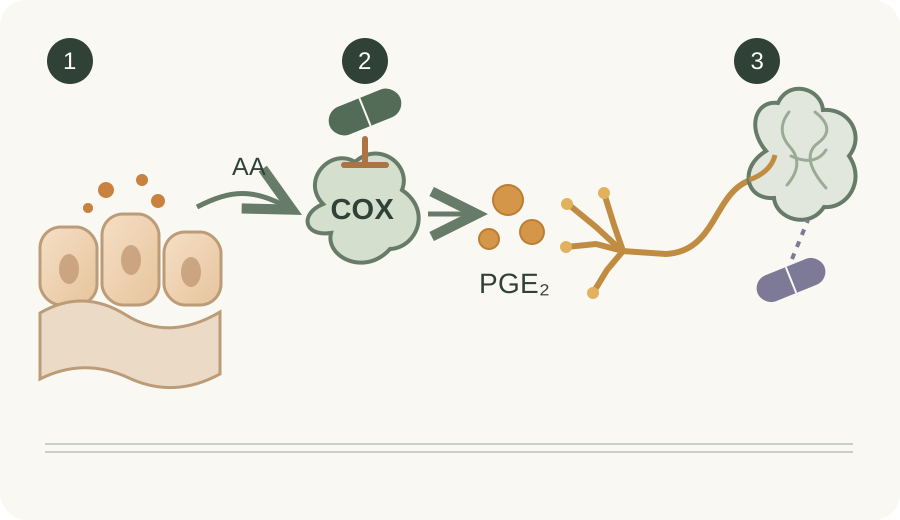
- Tissue irritation · Arachidonic acid · AA
- COX enzymes · Prostaglandins · PG · Airtal · COX inhibition
- Pain-sensing nerve · Paracetamol · central pain modulation
NSAIDs reduce inflammatory signaling; paracetamol (acetaminophen) acts mainly through central pain modulation.
The precise mechanism of paracetamol is not fully established. Medicine selection and combinations require individual assessment.
Sources for the mechanism diagrams
Simplified mechanism diagram
Disrupting bacterial cell-wall assembly
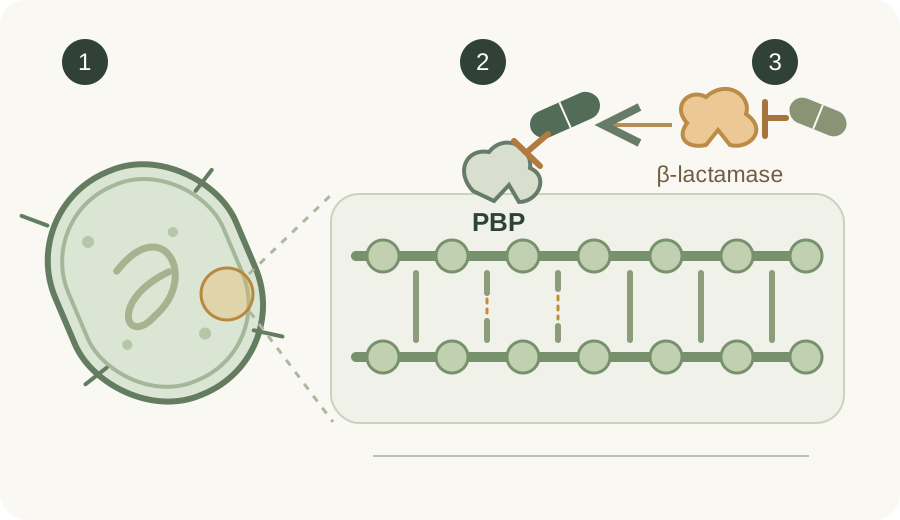
- Bacterial cell wall
- PBP · cell-wall enzyme · Amoxicillin · inhibits cross-linking
- β-lactamase · drug-degrading enzyme · Clavulanate · inhibits some enzymes
Amoxicillin disrupts cell-wall synthesis; clavulanate blocks certain enzymes that break it down.
This applies to susceptible bacteria. Antibiotic need is assessed individually; antibiotics do not replace treatment of the infection source.
Sources for the mechanism diagrams
01 PAIN · INFLAMMATORY PATHWAY
Managing pain and inflammation with Airtal.
Airtal contains aceclofenac. It is an NSAID anti-inflammatory pain medicine also used in orthopedic conditions such as arthritis, as well as dental pain and post-traumatic inflammation. We assess suitability according to postoperative pain and health.
How pain increases in peripheral tissues
Surgery and inflammatory stimuli
initiate inflammatory responses involving cell membranes.
A fatty acid derived from cell membranes
provides material for inflammatory mediators.
Enzymes involved in
prostaglandin synthesis.
Prostaglandins make pain-sensing nerves
more sensitive to stimuli.
Reducing prostaglandin production helps relieve pain and inflammation.
This approach reduces factors amplifying pain signals. We check gastrointestinal bleeding risk, kidney function, cardiovascular disease, allergies and other NSAID use before prescribing. Patients are advised not to add another NSAID to Airtal on their own.
Sources · Daewoong Airtal product information ↗ · Aceclofenac product information & mechanism ↗
02 COMPLEMENTARY ANALGESIA
Considering combinations of analgesics with different actions.
NSAIDs and acetaminophen act differently. When needed, combining these classes considers both inflammation at the affected site and central pain modulation. The ADA also lists NSAIDs alone or with acetaminophen as first-line options for acute dental pain. This does not mean every Airtal combination or dose is recommended for everyone.
Considering different sites of action together
Inhibits COX activity in peripheral inflammatory pathways
→ reduces prostaglandin production
Mainly modulates pain centrally
Its precise mechanism is not fully understood.
Why we do not start with Ultracet
Ultracet combines tramadol and acetaminophen. Tramadol acts on opioid receptors and inhibits serotonin and norepinephrine reuptake; nausea, vomiting, dizziness and drowsiness may occur. To reduce these burdens, we first consider non-opioid pain strategies. Persistent pain requires reassessment of the cause and prescription.
We review previous medication-related nausea, fasting, pain and recovery, and assess injectable analgesics or antiemetics when needed. We also check for duplicate acetaminophen in cold medicines or combination pain medicines.
Sources · ADA acute dental pain guideline ↗ · FDA acetaminophen information ↗ · DailyMed Ultracet information ↗
03 ANTIBIOTIC · CELL-WALL PATHWAY
Selecting necessary antibiotics by targeting bacterial cell walls.
Pain medicines and antibiotics serve different purposes. Antibiotics are used after assessing bacterial infection needs, alongside treatment of the source such as drainage or root canal care. The diagram below simplifies the actions of amoxicillin and clavulanic acid.
The roles of the two ingredients
Binds to penicillin-binding proteins involved in cell-wall synthesis
→ inhibits peptidoglycan cross-linking
→ disrupts cell-wall maintenance in susceptible bacteria
Inhibits certain β-lactamases that break down the antibiotic
→ helps protect amoxicillin from degradation
375 mg and 625 mg: looking at ingredients, not just the number.
| Labeled strength of the combination product | Amoxicillin | Clavulanic acid |
|---|---|---|
| 375mg | 250mg | 125mg |
| 625mg | 500mg | 125mg |
The 625 mg formulation contains more amoxicillin and the same amount of clavulanic acid. We choose the formulation and schedule according to infection extent and severity, kidney function, body size, allergies and medications. Two 375 mg tablets do not contain the same ingredient amounts as one 625 mg tablet. Take the prescribed formulation rather than changing it yourself.
Antibiotics do not eliminate every oral bacterium or biofilm. Plaque, calculus and the infection source still require direct treatment and follow-up.
Sources · Amoxicillin/clavulanic acid 375 mg product information ↗ · Amoxicillin/clavulanic acid 625 mg product information ↗ · ADA dental antibiotic guideline ↗
04 GUT MICROBIOME · PROBIOTICS
Considering gut balance during antibiotic treatment.
While acting against infection-causing bacteria, antibiotics can also affect the gut microbiome. These changes and the medicine itself may cause loose stools, diarrhea or abdominal discomfort, so we review symptoms before and after taking the medicine.
Gut microbial changes and supportive care
Some gut bacteria are also affected.
Gut balance and function may change.
We review diarrhea, abdominal discomfort and overall health.
We assess suitability of strains and products supported by evidence.
When appropriate, we consider probiotics as an adjunct. Strains, combinations and evidence differ, so products cannot be expected to have identical effects. They are not presented as completely restoring the microbiome. Suitability requires particular caution in immunocompromised or seriously ill patients. Contact the clinic for severe diarrhea, fever or blood in the stool.
Source · AGA probiotic guideline ↗
05 JAW MUSCLE · PAIN–TENSION LOOP
Distinguishing tension in the muscles around the jaw joint.
Jaw pain may involve chewing-muscle tension as well as the joint itself. We assess clenching habits, muscle tenderness, mouth opening and movement to evaluate muscle-related pain.
The cycle of pain and tension
Strain accumulates in the chewing muscles.
Discomfort and restricted movement may occur.
Pain may lead to repeated tightening and tension.
We consider habit management, physical therapy and medication when needed.
Considered as an adjunct to reduce pain associated with muscle tension or spasm.
Muscle relaxants for jaw muscles may be considered when needed. Medicines differ in action; we check drowsiness, dizziness and interactions with other sedatives. Conservative treatment and follow-up are used together. Muscle relaxants are not described as regenerating the joint disc or cartilage. Evidence and effects have limitations, so individual responses are monitored.
Learn about TMJ physical therapy & PDRN →Source · U.S. National Academies: treatment of temporomandibular disorders ↗
06 SINUS · POSTOPERATIVE RECOVERY
Checking nasal recovery after sinus surgery.
Illustration · not actual clinic products or an individual prescription photograph.
After a sinus lift with bone grafting, we assess nasal congestion, discharge and sinus symptoms as well as the surgical site. Symptoms and surgical progress guide whether nasal sprays or recovery medicines are appropriate, with instructions on use. Different sprays have different purposes and recommended durations.
Tell us about changes in pain, swelling, fever or nasal symptoms. Before prescribing, we review medicines from other clinics, allergies, liver, kidney and cardiovascular disease, and previous adverse reactions.
These diagrams explain general medication actions, not individual dosing instructions. Actual medicines, formulations, doses and duration are decided after examination. Review prescribed and existing medicines together and contact the clinic if you experience discomfort.